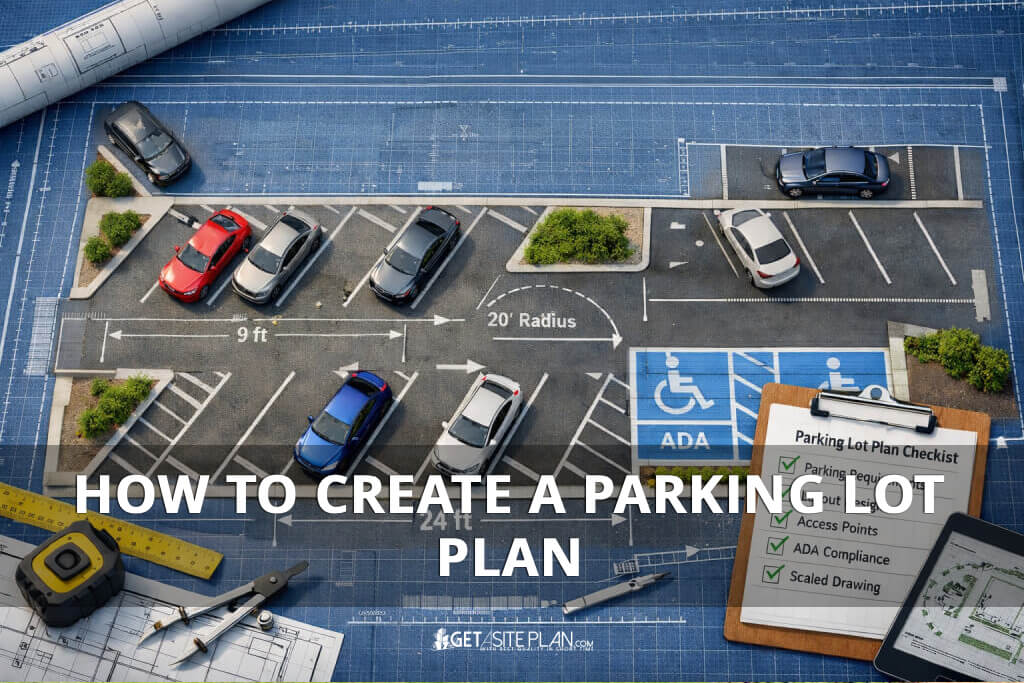
Creating a parking lot plan is one of the fastest ways to avoid permit delays when you’re building, expanding, or reconfiguring parking for a property.
In this guide, you’ll learn how to create a parking lot plan step-by-step, from planning the layout and choosing the right parking type to preparing a clean, permit-ready drawing.
If your city or county requires the parking layout as part of a broader submittal, we’ll also cover how it ties into a site plan and what to include to reduce revisions.
Creating a parking lot plan requires accurate dimensions, clear circulation, and compliance with zoning and ADA standards.
Parking lot plans are typically reviewed as part of a site plan submission, making scale and coordination essential for permits.
A permit-ready parking lot plan reduces revisions, shortens approval timelines, and helps projects move forward smoothly.
How to Create a Parking Lot Plan (Step-by-Step)
Steps for creating a parking lot plan
A parking lot plan is a scaled, permit-focused drawing that defines how parking spaces, drive aisles, and access points are arranged on a property.
When you create a parking lot plan, the goal isn’t just to show where cars park, it’s to demonstrate compliance, safety, and proper circulation so the layout can be reviewed and approved.
Creating a parking lot plan typically starts with understanding the site conditions and parking requirements, then translating those constraints into a clear layout with accurate dimensions. The final result should be a measurable drawing that can be reviewed by zoning or building departments and, in most cases, included as part of a site plan submission.
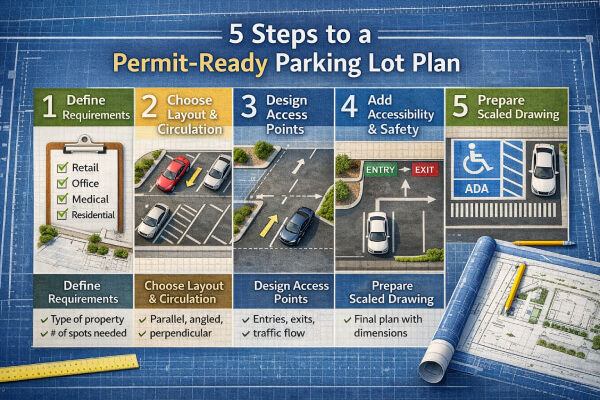
Creating a parking lot plan can be separated into 5 steps:
Define parking requirements and lot size
Choose the parking layout and circulation
Design access points and traffic flow
Add accessibility and safety features
Prepare a scaled parking lot drawing
Let’s see each of those steps in detail.
1. Define Parking Requirements and Lot Size
The first step in creating a parking lot plan is determining how many parking spaces are required and how much usable area is available on the site. Parking requirements are typically set by local zoning codes and vary depending on the type and use of the property.
Start by identifying the project type (as retail, office, medical, or residential) since each has different parking ratios. Then review the site boundaries, setbacks, existing structures – all elements that are first established through the broader site layout planning process. At this stage, the goal is not to design the layout, but to confirm that the site can accommodate the required parking without violating zoning or access rules.
Defining realistic parking requirements early helps avoid redesigns, circulation issues, and permit revisions later in the process.
2. Choose Parking Layout and Internal Circulation
Pick internal circulation and parking layout
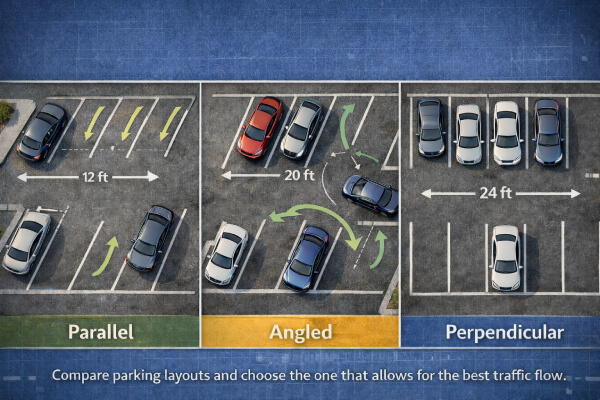
Once parking requirements are defined, the next step is selecting a layout that allows vehicles to move through the site safely and efficiently. Common layouts include angled, perpendicular, and parallel parking, each with different space and circulation requirements.
The chosen layout should minimize conflicts between vehicles and pedestrians while maintaining clear drive aisles and turning paths. This includes planning aisle widths, vehicle turning radii, and how cars enter, circulate, and exit the parking area without creating bottlenecks or blind spots.
A well-designed traffic flow improves safety and usability and is a key factor reviewers look for when evaluating parking lot plans for approval.
3. Design Access Points and Traffic Flow
Designing clear access points is a critical step in creating a functional parking lot plan.
This includes defining vehicle entry and exit locations, ensuring adequate spacing from intersections, and allowing enough room for safe turning movements. Poorly placed access points are a common reason parking lot plans require revisions during review.
Traffic flow within the lot should be intuitive and continuous, with clearly defined drive aisles that prevent cross-traffic conflicts and unnecessary reversing. Reviewers often look for layouts that reduce congestion and provide unobstructed paths for emergency and service vehicles.
In the United States, access and circulation design is typically reviewed against local zoning codes and safety guidance referenced by transportation agencies, such as the Federal Highway Administration (FHWA), which outlines best practices for access management and vehicle circulation [1].
While exact requirements vary by jurisdiction, planning departments consistently expect access points to support safe vehicle movement and clear sightlines throughout the parking area.
4. Add Accessibility and Safety Features
Adding accessibility and safety features
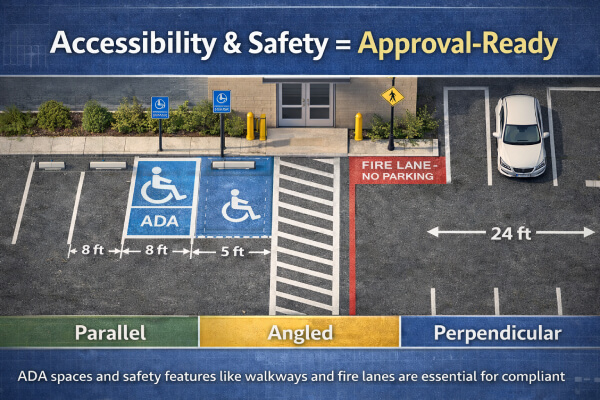
Accessibility and safety features are a required part of any professional parking lot plan, especially for commercial properties. This includes ADA-compliant parking spaces, access aisles, and clear routes connecting parking areas to building entrances.
In the United States, accessible parking requirements are defined under the Americans with Disabilities Act (ADA) and enforced by local jurisdictions during permit review [2]. The building permit cost for commercial projects typically ranges from $140 to $3,000, depending on project scope and local jurisdiction.
These guidelines specify the number of accessible spaces, their dimensions, signage, and proximity to accessible building entrances. Parking lot plans that omit or incorrectly size these elements are frequently rejected or returned for revision.
In addition to accessibility, parking lot plans may also indicate basic safety elements such as pedestrian paths, fire access lanes, and visibility considerations. Some jurisdictions also expect lighting locations or signage to be conceptually identified to support safe use of the site.
5. Prepare a Scaled Parking Lot Drawing
The final step is converting the layout into a scaled, dimensioned parking lot drawing that can be reviewed for permits. This drawing should accurately show parking spaces, drive aisles, access points, and required accessibility features, all positioned within the site boundaries.
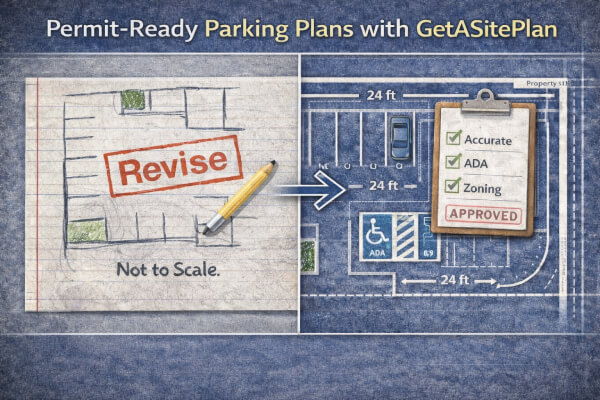
Most planning and building departments in the U.S. require parking lot plans to be drawn to scale, with clear dimensions and consistent notation. Hand sketches, unscaled layouts, or concept-only drawings are commonly rejected because they cannot be verified during review.
Projects that include concrete surfaces may also require a separate review – see our guide on permits to pour concrete for what to expect.
At this stage, the parking lot plan is typically included as part of a permit-ready commercial site plan submission, allowing reviewers to evaluate parking in relation to the overall property layout, circulation, and zoning requirements.
Parking Lot Layout, Dimensions & Design Guidelines
Guidelines for parking lot design and layout dimensions
Parking lot plans rely on standardized layouts and dimensions to ensure safe circulation, proper spacing, and regulatory compliance. These guidelines define how parking spaces, drive aisles, and access paths are arranged so the lot can function efficiently and pass permit review.
While exact requirements vary by jurisdiction, most parking lot plans follow widely accepted dimensional standards for stall sizes, aisle widths, and turning clearances. Reviewers expect parking layouts to be drawn to scale, with consistent spacing and clear circulation patterns that prevent congestion and unsafe vehicle movements.
Design guidelines also focus on usability. A well-planned parking lot balances capacity with safety, avoids forced or overly tight layouts, and clearly separates vehicle and pedestrian areas. Applying these principles early helps reduce revisions and improves approval timelines.
Standard Parking Space Dimensions
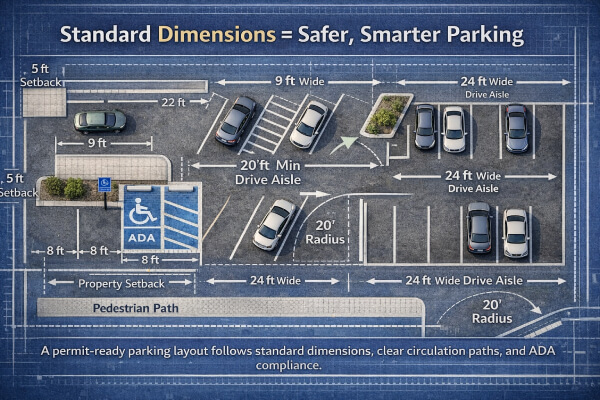
Standard parking space dimensions define the minimum width, length, and clearance needed for safe and functional parking. In the United States, most parking lot plans follow commonly accepted dimensional ranges that support vehicle maneuvering and regulatory review.
Parking spaces, drive aisles, and clearances must be drawn to scale and shown with clear measurements. Local zoning codes and federal accessibility standards, including ADA requirements, are typically used to verify that parking dimensions meet permit criteria.
Accurate dimensions help prevent circulation issues and reduce the likelihood of plan revisions during review.
Parking Lot Floor Plan With Dimensions
Floor plan of parking lot with dimensions
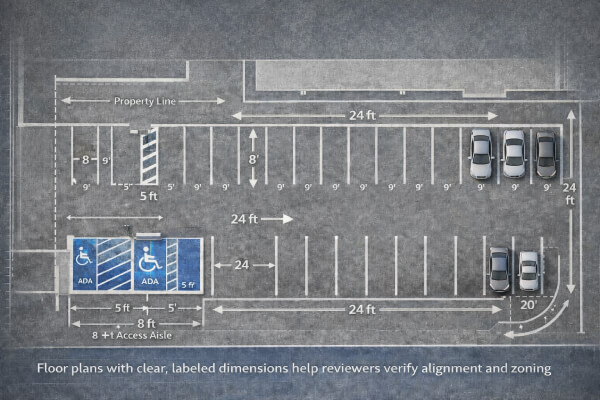
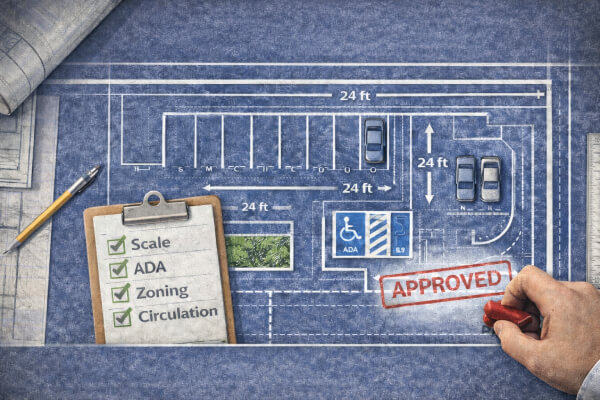
A parking lot floor plan shows the exact placement and dimensions of parking spaces, drive aisles, and circulation areas within the site. Unlike conceptual layouts, a floor plan is a measurable drawing used by reviewers to verify spacing, alignment, and compliance.
Dimensions should be clearly labeled and consistent throughout the plan, allowing planning departments to confirm that parking fits within property boundaries and required setbacks. Clean, well-dimensioned floor plans help reviewers assess parking quickly and reduce the need for revisions.
Parallel vs Angled Parking Layouts
Parallel and angled parking layouts are chosen based on space availability, traffic flow, and site geometry. Parallel parking is typically used where space is limited, while angled parking allows easier entry and exit and can improve circulation in larger lots.
Angled layouts often require more area but reduce maneuvering complexity, making them common in commercial parking lots. Parallel layouts are more space-efficient but demand wider aisles and careful circulation planning.
Selecting the appropriate layout helps balance parking capacity with safe and efficient vehicle movement.
Efficient Parking Lot Layout Principles
Efficient principles for parking lot layout
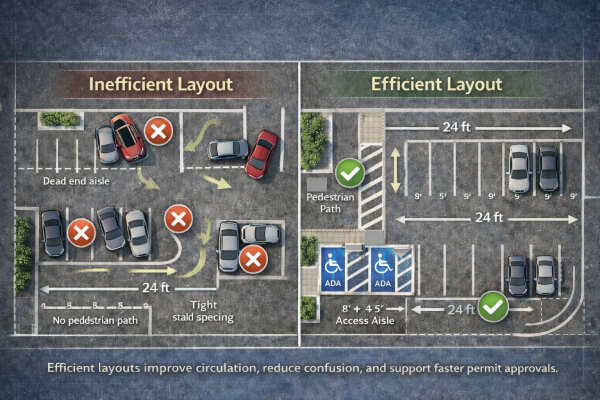
An efficient parking lot layout balances parking capacity, circulation, and safety without forcing vehicles into tight or confusing movements. Clear drive aisles, logical space alignment, and minimal dead ends help reduce congestion and improve usability.
Efficient layouts also separate vehicle and pedestrian paths where possible and maintain consistent spacing throughout the lot. Reviewers typically favor parking plans that demonstrate clear circulation and practical use of space, rather than layouts that maximize space count at the expense of safety.
Applying these principles early improves both day-to-day function and permit approval outcomes.
With layout and dimensional standards in place, the next common question is how much time and budget are typically involved in creating a professional parking lot plan.
How Much Does It Cost to Create a Parking Lot Plan?
Parking lot plan cost
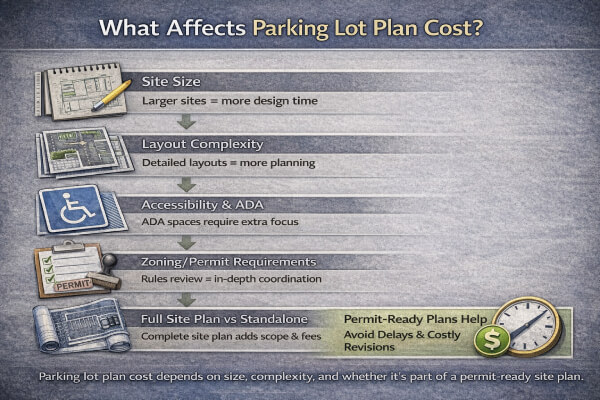
The cost of creating a parking lot plan depends on several factors, including site size, project complexity, and local permit requirements. Smaller projects with straightforward layouts typically require less documentation, while commercial sites with accessibility, circulation, and zoning constraints involve more detailed planning.
Pricing is also influenced by whether the parking lot plan is prepared as a standalone drawing or as part of a full site plan submission. Plans created specifically for permit approval usually include scaled dimensions, compliance notes, and coordination with site boundaries, which adds to the overall scope.
In general, investing in a properly prepared parking lot plan helps avoid revisions, resubmittals, and delays that can increase costs later in the approval process.
Can You Create a Parking Lot Plan for Free?
Possibility of creating a free parking lot
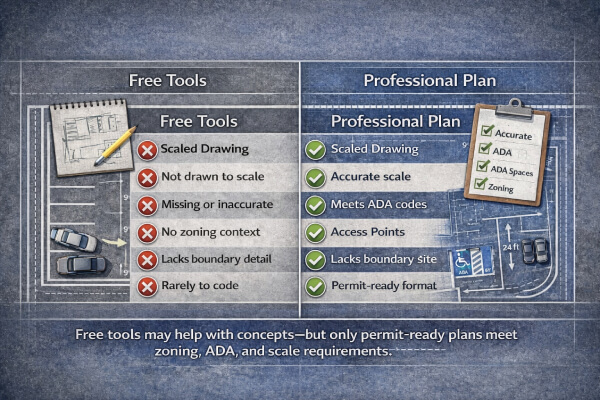
Free tools, templates, and online generators can be useful for early concept ideas, but they are rarely sufficient for permit approval. Most free options lack accurate scaling, zoning context, and accessibility compliance, which are required during review.
Planning departments typically evaluate parking lot plans as technical, measurable drawings, not conceptual layouts. Plans that are not drawn to scale or that omit required details, such as dimensions, access points, or ADA-compliant spaces are commonly rejected or returned for revision.
For projects that require permits, a professionally prepared parking lot plan helps ensure the layout meets local requirements and integrates correctly with the overall site plan, reducing delays and resubmittals.
Permit-Ready Parking Lot Plans With GetASitePlan
Parking lot plans designed with a help of GetASitePlan
For most permit applications, a parking lot plan is reviewed as part of a site plan submission, not as a standalone sketch. Planning departments expect parking layouts to be accurately scaled, dimensioned, and coordinated with property boundaries, access points, and zoning requirements.
With GetASitePlan, parking layouts are prepared as part of a complete site plan for permits, ensuring that space counts, circulation, and accessibility features align with local standards and reduce the risk of revisions.
By integrating the parking lot plan into a professionally drafted site plan for permits, property owners and contractors can streamline the approval process and avoid delays caused by incomplete or non-compliant drawings.
FAQ – How to Create a Parking Lot Plan
Do I need professional software to create a parking lot plan?
No. Permit approval depends on whether the parking lot plan is accurately scaled, dimensioned, and compliant, not on the software used to create it.
Are free parking lot templates acceptable for permits?
No. Free templates usually lack site-specific dimensions, zoning context, and accessibility details required for permit review.
Who can prepare a parking lot plan for a commercial property?
A parking lot plan can be prepared by architects, engineers, or professional site plan drafting services such as GetASitePlan.
Parking Lot Plans That Pass Review With GetASitePla
Pass Parking lot plans review with GetASitePlan
Creating a parking lot plan is a permit-focused process that depends on accurate dimensions, clear circulation, and compliance with zoning and accessibility standards.
Parking layouts are typically reviewed as part of a site plan submission, which makes coordination and precision critical. By integrating the parking lot plan into a professionally prepared site plan, property owners and contractors can reduce revisions and avoid approval delays. If your project requires a site plan for permits, working with an experienced drafting service can help move the process forward with fewer setbacks.
Contributing Writer | Architecture & Design Writer
During my career, I’ve written articles on interior design, home remodeling, and renovation with an emphasis on money-saving tips and DIY ideas. It’s been a rewarding journey and I am thrilled to continue helping others bring their architectural visions to life.
A topographic site plan shows how land rises, falls, drains, and changes across a property. The main clues are contour lines, spot elevations, slope direction, grade breaks, ridges, valleys, depressions,
You do not need to surround an entire property with an expensive fence to gain privacy. In many yards, the cheapest solution is to block the specific line of sight
A home renovation runs more smoothly when decisions happen in the right order. Define the work first, document existing conditions, confirm permit requirements, prepare drawings, build the budget, hire contractors,