You can obtain a site plan of your property by requesting existing drawings from your local building department, checking county property records, contacting the original builder, or ordering a new site plan online. If your project requires certified boundary measurements, you’ll need a licensed land surveyor.
The quickest starting point is to check whether your property already has a site plan on file. If no suitable drawing exists, you can have one prepared using property records, satellite imagery, and measurements.
At Get a Site Plan, we create scaled, non-certified site plans for residential and commercial properties. Our drawings are prepared remotely and can support permit and HOA applications where non-certified plans are accepted.
We do not establish legal property boundaries or replace licensed surveyors, architects, or engineers when their services are required.
Here’s how to find an existing site plan, obtain a new one, and determine which option is appropriate for your project.
Where Can I Get a Copy of My Property’s Site Plan?
There are four places worth checking before paying for a new drawing. The availability of existing plans depends on the property’s history and local recordkeeping practices.
1. Local Building or Planning Department
Your city or county building department is usually the best starting point.
When someone applies for a construction permit, the application may include a site plan showing the property layout and proposed improvements. Some departments retain approved drawings and make them available through online permit databases.
For example, the City of Seattle provides a permit and property research system where homeowners can search historical permits, plans, and related documents. Certain construction drawings require a separate records request.
To find your site plan:
Visit your city’s building or planning department website.
Find the property records or permit history section.
Search using your address or parcel identification number.
Look for documents labeled “site plan,” “plot plan,” or “approved plans.”
Download the drawing or request a copy from the department.
Keep in mind that an old site plan might not reflect your property’s current condition. Additions, demolished structures, and other changes must be accounted for before reusing it.
2. County Assessor or GIS Department
County assessors maintain parcel information for property taxation, while geographic information system (GIS) departments provide digital maps.
Depending on the county, these resources can show:
Parcel identification numbers
Approximate property boundaries
Lot dimensions and acreage
Building footprints
Aerial imagery
Zoning information
These records provide a useful starting point for preparing a new site plan.
However, a parcel map is generally not equivalent to a site plan or legal boundary survey. As the Alameda County Assessor explains, assessor maps show approximate boundaries and cannot establish exact property lines.
3. County Recorder or Land Records Office
Your county recorder, register of deeds, or equivalent land records office maintains recorded property documents.
You can request deeds, subdivision plats, recorded surveys where available, and documents describing easements.
A title report may also identify recorded easements or reference surveys, although it does not automatically include a site plan.
If you recently purchased your property, check your closing documents first. You may already have a survey or recorded plat that can help a drafter prepare your site plan.
4. Original Builder, Architect, or Previous Owner
If your home was constructed recently, contact the builder or architectural firm responsible for the project.
They may still have drawings showing the original property layout, driveway, structures, and proposed improvements.
You can also ask the previous owner whether they retained plans from a construction or remodeling project.
Original construction documents are particularly useful when public records are incomplete.
How to Obtain a New Site Plan If You Can’t Find One
If your property has no existing site plan, or the available drawing is outdated, you have three main options.
Method
Best Suited For
Main Consideration
Draw it yourself
Simple projects where homeowner drawings are accepted
Some jurisdictions accept homeowner-prepared site plans for straightforward residential improvements.
Start with a parcel map or existing survey, then measure the buildings and other relevant features.
Your drawing should be to scale and clearly distinguish existing structures from proposed construction.
For example, the City of Portland permits homeowners to prepare residential drawings and provides a detailed site plan preparation guide. Its requirements include a north arrow, property dimensions, and a scale of 1 inch to 10 feet or larger. Other jurisdictions have different standards.
Drawing your own plan can be inexpensive, but measurement errors and missing information can result in requests for corrections.
Ordering a professionally drafted site plan online is a convenient option when your local authority accepts non-certified drawings.
At Get a Site Plan, we prepare drawings using available GIS information, satellite imagery, public property records, and measurements supplied by our customers.
You can order a plan without arranging an on-site visit.
Our process involves three steps:
Choose your plan. Select a package based on the details required for your project.
Provide your property address. Include existing surveys, sketches, dimensions, or project instructions if available.
Review your drawing. We prepare the plan and deliver it digitally, allowing you to request revisions when necessary.
Our standard turnaround is 6–24 hours, depending on the service selected.
For projects involving a shed, fence, driveway, pool, or garage addition, we can also show proposed construction and its position relative to existing features.
The important distinction is certification. Our drawings use approximate property boundary information and cannot replace a legal survey.
Option 3: Hire a Licensed Land Surveyor
A licensed land surveyor is necessary when accurate legal boundary determination or a certified survey is required.
Examples include boundary disputes, uncertain property corners, some subdivision projects, and developments requiring survey-grade measurements.
Surveyors can conduct field measurements, research legal descriptions, and prepare professional surveys within their licensed scope.
Our guide comparing a site plan vs. survey explains the differences between these documents.
Before hiring anyone, ask the permitting authority whether it requires a boundary survey, topographic survey, certified site plan, or another specific document.
What Information Should a Site Plan Include?
Get A Site Plan creates custom, detailed site plans and plot plans for property owners who need permits for new home purchases, construction, or changes like adding a garage or fence.
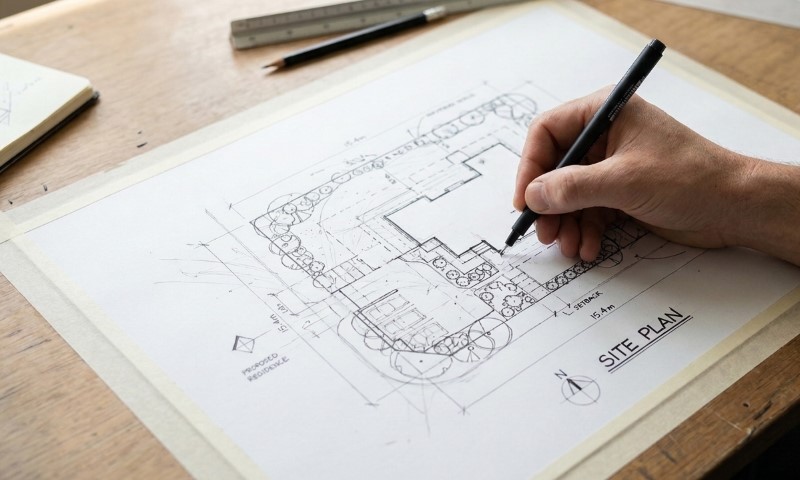
A complete site plan gives reviewers a scaled overview of the property and the proposed changes.
The exact requirements depend on the project and local regulations.
Most residential site plans include the following information:
Site Plan Element
What It Shows
Property boundaries
Perimeter and lot dimensions
Existing structures
House, garage, shed, and other buildings
Proposed structures
New construction and additions
Setbacks
Distances between structures and property lines
Access features
Driveways, sidewalks, and entrances
North arrow and scale
Orientation and proportional measurements
Property identification
Address and parcel number
Some applications also require easements, utilities, trees, drainage features, grading, or impervious surface calculations.
The City of Seattle’s site plan requirements provide an example of the information needed for construction and land-use permits. The guidance was revised in August 2025.
For a simple fence project, a basic drawing may be enough. A new house or substantial addition can require significantly more technical information.
How Much Does It Cost to Obtain a Site Plan?
The cost depends on whether you’re retrieving an existing document or commissioning a new drawing.
Requesting an existing plan may be free through an online public records portal. Other departments charge records retrieval or reproduction fees.
For example, Portland makes certain historical permit drawings available online and provides a separate process for requesting additional records. Portland’s public records guidance explains the available options.
If you need a new site plan, our current standard package prices are:
Get a Site Plan Package
Listed Price
Simple
$89
Medium
$119
Premium
$159
Gold
$259
These are our published base prices as of October 2026. Optional services can affect the final amount.
Licensed surveying costs vary based on property size, terrain, available records, and the scope of required fieldwork.
How to Submit Your Site Plan for Approval
Once you have your drawing, the next step depends on why you need it.
For a construction project, start by confirming the applicable building permit requirements with your local authority.
The usual submission process involves:
Completing the required permit application.
Attaching the site plan and other requested drawings.
Submitting the documents through the designated portal or office.
Paying applicable application fees.
Responding to requests for clarification or revised drawings.
A site plan is one component of the application. Permit approval depends on the complete proposal and its compliance with applicable requirements.
For projects governed by a homeowners’ association, check the association’s architectural review procedures. Our HOA approval guide explains the typical documentation and submission process.
If your drawing is rejected, read the reviewer’s comments before ordering a replacement. Missing dimensions or labels may require a straightforward revision.
A requirement for certified boundaries means you’ll need an appropriately licensed professional.
FAQs
Yes, if an existing drawing is available through a free public records portal. You can also prepare your own drawing when local rules permit it, although you’ll need reliable property information.
Yes. Search your city or county’s permit records database using your property address or parcel number. If no drawing is available, you can order a new non-certified site plan online.
No. A site plan shows the property layout and existing or proposed improvements. A boundary survey establishes precise property boundaries through professional surveying methods.
Not for every project. Some authorities accept homeowner drawings or professionally drafted non-certified plans. A licensed surveyor is required when the applicable rules call for a certified survey or professional boundary determination.
Existing online records can be downloaded immediately when available. Public records requests depend on the department’s processing schedule. At Get a Site Plan, standard drawing delivery is typically 6–24 hours.
Yes, if the reviewing authority accepts it and the drawing accurately reflects the property’s current conditions. Any new structures or proposed improvements must be shown as required.
Our Design & Drafting Team consists of experienced CAD designers specializing in site plans, floor plans, elevations, and property drawings for residential and commercial projects.
Our content is based on hands-on drafting experience and the real-world questions we encounter while helping property owners, contractors, and professionals prepare drawings for permits, HOA submissions, and project planning.
Residential development is the process of planning, designing, and constructing housing on land intended for residential use. Projects range from individual homes and townhouse communities to apartment buildings and entire
The average cost to pave a driveway in 2026 is approximately $4,900, with most homeowners spending between $2,500 and $7,300. Asphalt paving typically costs $7 to $13 per square foot,
Adding a dormer to your roof typically costs $6,000 to $25,000 in 2026, with a national average of approximately $15,000. Larger dormers, complicated roof modifications, and projects involving finished living