
What Is a Site Plan: Definition, Elements and Examples
Planning a home addition, building a garage, or installing a swimming pool usually involves more than deciding where the new structure should go. You also need to show how the




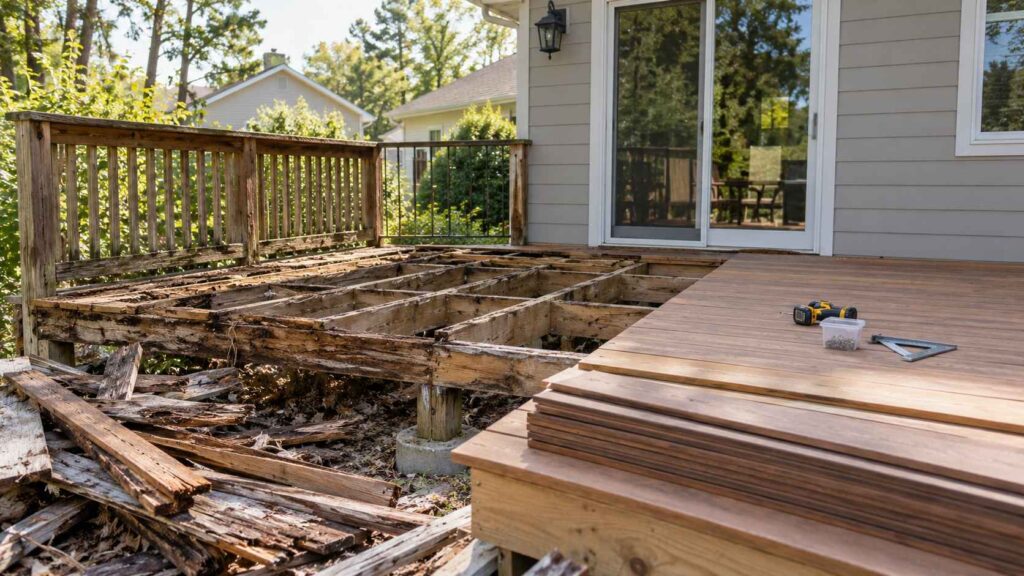

Deck repair costs average $1,465 in 2026, with most homeowners spending between $570 and $2,600. Complete deck replacement typically costs $5,420 to $14,540 for smaller or straightforward projects, although larger decks and premium materials can push the total beyond $25,000.
According to 2026 deck repair cost data, minor repairs can cost as little as $150, whereas extensive structural damage can require several thousand dollars in repairs.
The biggest question is whether your existing deck can safely be repaired or needs rebuilding. We’ll break down replacement costs, common repairs, materials, labor, and additional expenses to help you make that decision.

Repairing a few damaged boards costs considerably less than replacing an entire deck. However, resurfacing an otherwise sound structure is different from rebuilding its foundations, posts, beams, and framing.
Here’s what homeowners can expect to pay in 2026.
| Project | Estimated Cost |
|---|---|
| Minor deck repairs | 150–500 |
| Typical deck repairs | 570–2,600 |
| Deck board replacement | 10–35 per sq. ft. |
| Full deck resurfacing | 15–50 per sq. ft. |
| Complete deck replacement | 5,420–14,540+ |
The replacement range primarily reflects smaller and moderately priced projects. Larger professionally installed decks frequently cost more.
For perspective, Zonda’s 2025 Cost vs. Value Report estimated the national average cost of a new wood deck at $18,263 and a composite deck at $25,096.
Those figures describe standardized new deck additions, rather than replacing existing structures. They’re useful benchmarks, but demolition and unforeseen structural work can increase a replacement project’s final cost.

Deck size has a direct impact on replacement costs because larger projects require more decking, framing, fasteners, foundations, and installation labor.
For a straightforward professional rebuild, a useful preliminary allowance is approximately $35 to $75 per square foot, including removal of the existing structure. The estimate combines typical new-deck construction and demolition costs; it isn’t a guaranteed contractor quote.
| Deck Size | Square Footage | Estimated Replacement Cost |
|---|---|---|
| 10 × 10 ft. | 100 | 3,500–7,500 |
| 12 × 12 ft. | 144 | 5,040–10,800 |
| 12 × 16 ft. | 192 | 6,720–14,400 |
| 16 × 20 ft. | 320 | 11,200–24,000 |
| 20 × 20 ft. | 400 | 14,000–30,000 |
Estimates are illustrative planning ranges for straightforward replacements. Complex foundations, elevated construction, premium railings, permits, and extensive site preparation can increase costs.
A 12-by-12-foot ground-level deck will generally be cheaper to rebuild than an equally sized deck elevated several feet above the yard.
Height matters because elevated structures need appropriate foundations, supports, lateral stability, stairs, and safety guards.
If you’re considering a completely different layout, our guide to deck building costs explains the expenses associated with new construction.


Deck repairs range from replacing loose fasteners to rebuilding damaged structural components.
| Repair Type | Typical Cost |
|---|---|
| Replacing loose nails or fasteners | 150–200 |
| Replacing damaged boards | 10–35 per sq. ft. |
| Replacing a damaged joist | 150–350 |
| Repairing deck railings | 465–4,335 |
| Repairing deck stairs | 115–300 |
| Repairing insect damage | 250–2,350 |
| Mold or mildew remediation | 215–515 |
| Sealing or staining | 1.15–4.70 per sq. ft. |
A single broken board is generally inexpensive to replace. Problems become more costly when contractors discover deterioration beneath the deck surface.
For example, water-damaged decking could indicate rotting joists, failed flashing, or moisture trapped near the house.
An inexpensive surface repair isn’t a bargain if the underlying structure remains unsafe.
That’s why we recommend inspecting the entire deck before choosing between repairs and replacement.

Replacing deck boards without rebuilding the frame is commonly called deck resurfacing or redecking.
It usually costs between $15 and $50 per square foot, depending on materials, labor, and preparation.
For a 200-square-foot deck, that produces an estimated resurfacing budget of $3,000 to $10,000.
Material selection affects both installation costs and future maintenance.
Before switching from wood to composite, have the existing frame inspected.
Composite products can require specific joist spacing, fastening systems, and structural support. A frame originally built for wood decking isn’t automatically suitable for every composite product.

Replacing railings typically costs $35 to $210 per linear foot, depending on material and design.
Wood railings usually cost less than premium composite, cable, or glass systems.
Railings are essential safety components on elevated decks. A loose or unstable railing should be assessed promptly rather than treated as a cosmetic issue.

Beyond square footage, several factors can significantly change a contractor’s estimate.
Removing an old deck generally costs $5 to $15 per square foot, including demolition and material removal.
Difficult access, heavy concrete footings, or extensive disposal requirements can increase the price.
Local labor rates, deck height, framing complexity, and site conditions affect installation costs.
A replacement requiring new foundations, beams, ledger connections, and stairs will cost considerably more than installing new boards over an approved existing frame.
Sloping land, unstable soil, poor drainage, and underground utilities can complicate construction.
Sometimes the problem responsible for damaging the original deck must be corrected before rebuilding it. Ignoring drainage or foundation problems can shorten the replacement deck’s service life.
Custom stairs, privacy screens, built-in seating, lighting, pergolas, and premium railings increase expenses.
If your budget is limited, we’d prioritize structural quality and durability before decorative upgrades. Upgrading the railings later is considerably easier than correcting inadequate foundations.
The decision depends more on structural condition than appearance.
The North American Deck and Railing Association’s inspection guide identifies critical inspection areas, including footings, posts, beams, joists, ledgers, decking, stairs, and guards.
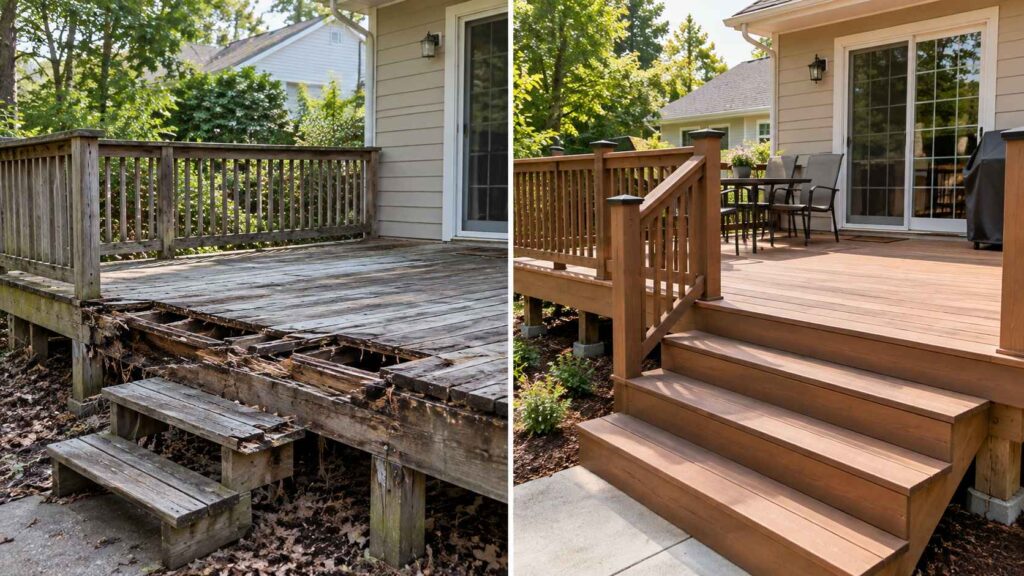
Deck age alone doesn’t determine whether replacement is necessary. A well-maintained older deck can remain serviceable, whereas a newer structure with serious construction defects can be unsafe.
We’d also be cautious about spending several thousand dollars resurfacing a frame that’s approaching the end of its usable life.
A qualified deck contractor or structural engineer should evaluate suspected structural damage before you commit to repairs.
Many deck replacement projects require a building permit, particularly when structural framing, foundations, dimensions, or attachment to the house change.
According to the 2024 International Residential Code, certain decks can be exempt from building permits if they meet all applicable conditions, including:
Local adoption and amendments determine whether these exemptions apply. Even permit-exempt projects must follow applicable zoning rules and other legal requirements.
For an explanation of the application process, see our deck permit guide.
Deck permit fees commonly run approximately $150 to $500, although local charges vary.
Your building department may request a deck site plan showing the proposed footprint, property boundaries, setbacks, buildings, stairs, and surrounding features.
At Get a Site Plan, we prepare non-certified deck permit site plans remotely using available property records, GIS information, satellite imagery, and project measurements.
Our plans help document the proposed layout for permit or HOA submissions. They don’t replace structural drawings, legal surveys, or licensed professional services when required, and the local reviewing authority decides what documentation is acceptable.
If your neighborhood has architectural restrictions, check the HOA approval requirements before committing to a new design.

Lowering costs shouldn’t mean compromising structural safety.
A few practical strategies can make a meaningful difference:
We’d also allow an additional 10% to 15% of the project budget for unexpected work, especially when replacing an older deck.
Hidden rot is difficult to price until contractors remove the surface.
A complete 12-by-12-foot deck replacement can cost approximately $5,040 to $10,800 for straightforward construction, including removal. Elevated designs, expensive materials, and additional structural work can increase the price.
Repairing is usually cheaper when damage is localized and structural components remain sound. However, extensive repairs involving multiple supports, stairs, and railings can approach replacement costs. Compare both options after a professional inspection.
Professional deck board replacement generally costs $10 to $35 per square foot for affected areas. Full resurfacing commonly runs $15 to $50 per square foot, depending on materials and preparation.
Yes, provided the existing framing is structurally sound, meets applicable requirements, and supports the selected decking material. Contractors should inspect joists, beams, posts, fasteners, and connections before reusing the frame.
A straightforward deck replacement can take several working days to around two weeks once construction begins. Larger elevated decks, complicated foundations, weather delays, and inspections can extend the schedule. Permit review adds time before construction.
Homeowners with suitable skills can handle some nonstructural repairs, including replacing damaged boards and refinishing surfaces. Structural repairs, railing connections, foundations, and elevated deck reconstruction require greater expertise and should generally involve qualified professionals.
A well-built deck can increase a property’s resale appeal. Zonda’s 2025 report estimated that new wood deck additions recovered 94.9% of their cost at resale nationally, compared with 88.5% for composite additions. Those are modeled national benchmarks, not guaranteed returns for individual replacement projects.

Planning a home addition, building a garage, or installing a swimming pool usually involves more than deciding where the new structure should go. You also need to show how the
Adding a room to your house costs approximately $48,000 on average in 2026, with many homeowners spending between $20,900 and $72,600. Larger additions, bathrooms, and primary suites can cost considerably
Building a new deck costs $8,321 on average in 2026, with most homeowners spending between $4,339 and $12,653. According to Angi’s 2026 deck cost data, those figures come from more
